
Check the acquisition promise
Read the store headline, screenshots and description. What problem is the app promising to solve?
Study the storefront ↗
IrcamLab · iOS
Explore the ad evidence, study the storefront, and build your next acquisition hypothesis.
01 / Creative research
Read the store headline, screenshots and description. What problem is the app promising to solve?
Study the storefront ↗Explore apps with direct store-link matches. Compare their hooks and formats without assuming the same approach works here.
Browse observed advertisers ↗Store rankings and revenue estimates describe market context. They do not establish ad spend, conversions or ROAS.
Review the market context ↗02 / Storefront & product
Study the product story and store experience behind the acquisition funnel.

03 / Market context
Keep revenue, downloads and store rankings separate from advertising performance.
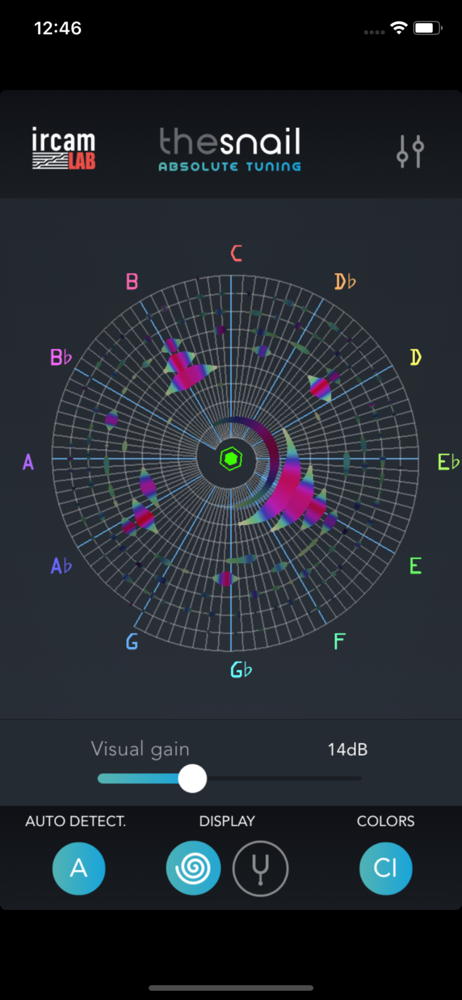
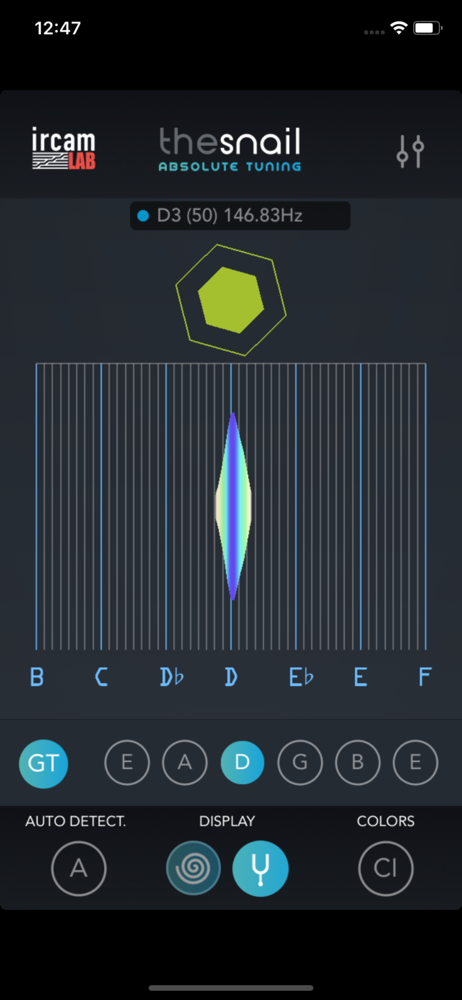
The ability to tune multiple instruments at once and pin point the frequencies of sound we would not normally be able to discern as pitches is incredible. What brings this app down, however, is that it does not retain settings after closing and does app does not reorient when the device is turned sideways or upside down.
This is the only tuner I know of which can be used as an exploratory tool. The combination of a sensitive visual representation of pitch and a useful level of spectral analysis allows us to focus on timbre, which is notoriously difficult to evaluate objectively. That’s both because we are so close to the sound source, and because our experience of the sound may be dominated by radiators on the instrument which are less important to a listener who has a different spatial relationship to the sound. That’s true whether we’re playing a string, a wind, or a percussion instrument. (Paragraph) I do have a few suggestions for ongoing development of the tool. First, the tuner is biased toward the Western equal-tempered 12 tone scale. It would be great to be able to specify a model octave of a scale from other traditions, like South Asian or Middle Eastern, or from other historical Western tuning systems. The model octave could be specified with a simple table of frequencies with a few decimal points of resolution, and ideally I would be able to build a personal library of scale tunings. (Paragraph) The division of the semitones into eight buckets helps to reduce visual complexity, but a preference switch to increase that to ten would allow me to visualize the pitch deviations in units of ten cents. That might not be workable for the small screen of a phone, but there’s enough real estate on an iPad screen for that to be usable. (Paragraph) Similarly, a preference switch to activate the lines between the “correct” pitches for reference pitch production would help me work on microtonal pitch discrimination. (Paragraph) Previous review follows: Hey, IRCAM - you built something wonderful and useful! Please update it so it will run on iPadOS!
Used it for years. Was bummed out when it stopped working on recent versions of iOS but they finally fixed it. It’s a brilliantly clever way to view frequencies as you can see the harmonics of your instrument or voice as well. It’s also available as a VST plugin and I use it with Gig Performer to tune my guitar during a show.
Similar to the human cochlea where the different frequencies are split-up and analyzed, The Snail for iOS uses a spiral grid to visualize root notes a...


